
Honeymoon planning guide
How to plan your honeymoon, together
Work through a honeymoon planning checklist, agree on shared priorities and see a completed budget example from our printable honeymoon planner.
- Both partners' priorities
- Two voices
- Fictional trip example
- 4 nights
- Invented whole-trip budget
- USD 2,400
Start with what each of you wants
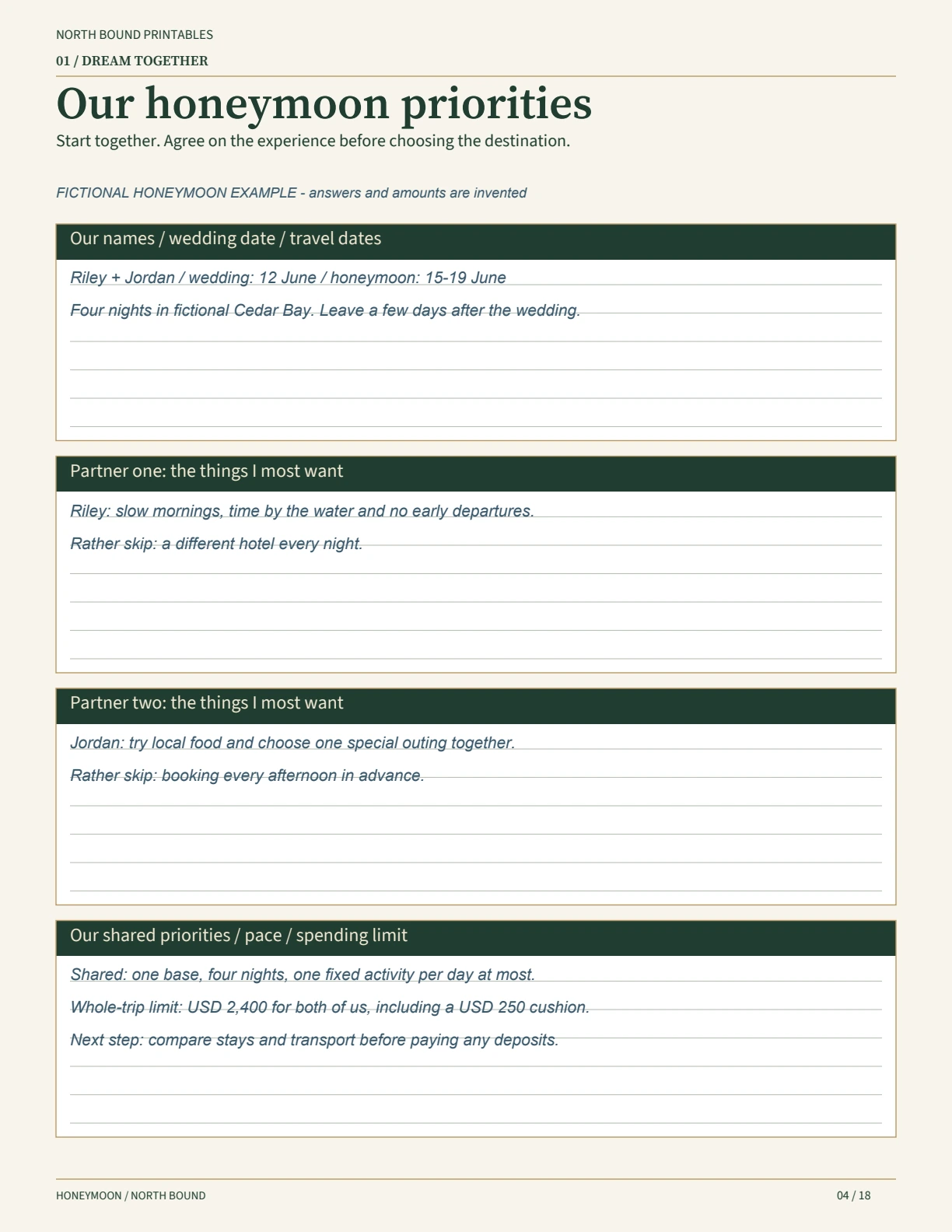
Before choosing a destination, each partner writes what they most want and what they would rather skip. Compare those answers before filling the calendar. An unhurried breakfast, time outside or a special meal can matter more than adding another stop.
Our example follows Riley and Jordan on a fictional four-night honeymoon in Cedar Bay, from 15 to 19 June after their 12 June wedding. Riley wants slow mornings and one base; Jordan wants local food and one special outing. They agree to at most one fixed activity each day and a USD 2,400 total limit. These names, places, dates and amounts are invented. The completed images use actual worksheets from our 18-page Illustrated Edition; purchased worksheets are blank for your own answers.
Compare destinations before paying deposits
Use Compare two destinations on page 5 to put two realistic options beside each other. Record the journey, stay, total expected cost and whether each option gives you the experience you agreed on. Compare the whole trip, not only a headline room rate.
Riley and Jordan use their shared priorities as the test: can they stay in one place, arrive without an early start and leave afternoons open? Anything unknown becomes a question to ask before booking. Check current entry, transit and carrier requirements for your own nationality, route and dates; the U.S. reference below is for U.S. travelers, not every couple.
Set one honeymoon budget for the whole trip
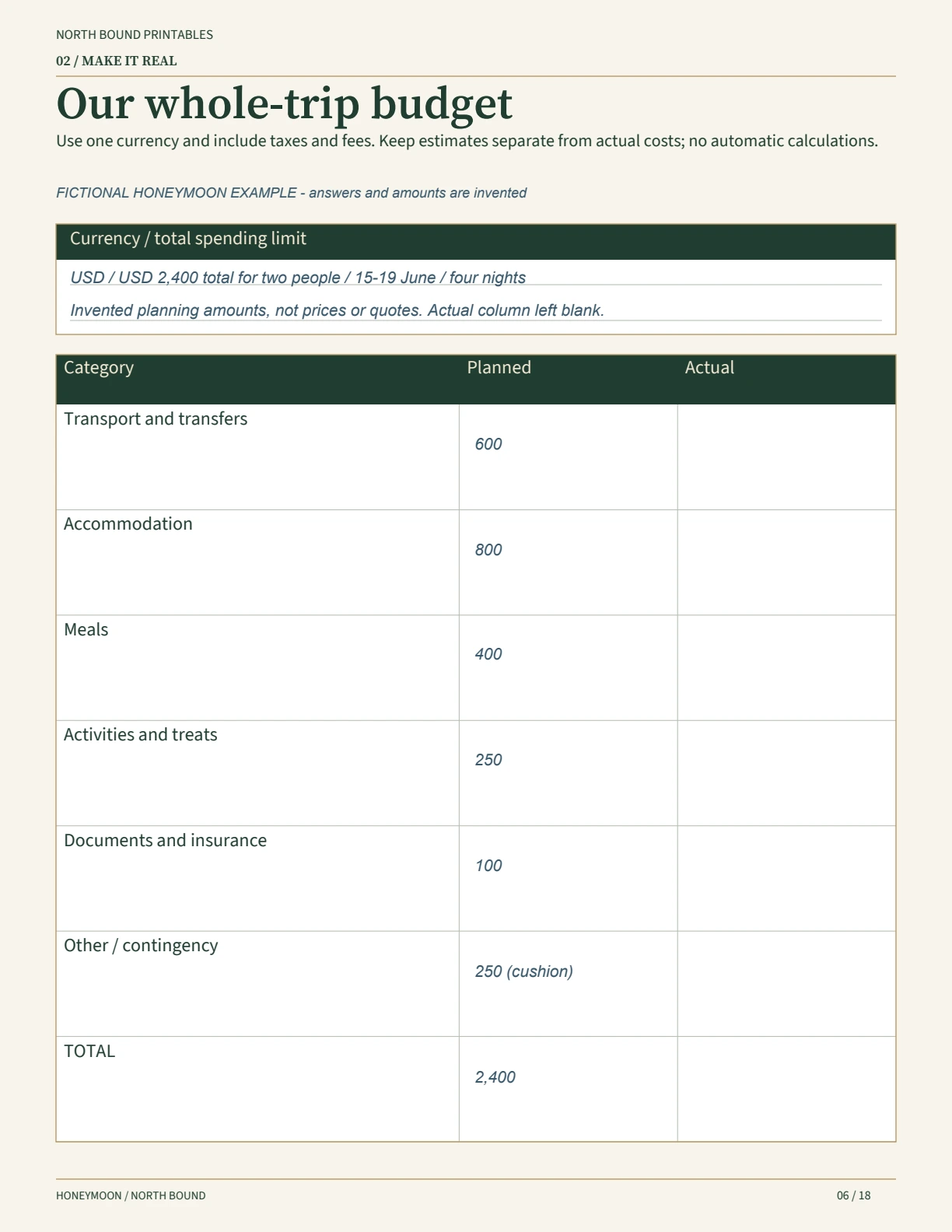
Our whole-trip budget on page 6 separates planned and actual costs. Choose one currency and include taxes and fees. If more than one currency is involved, record the conversion assumption and any fees separately, then revisit them when you pay.
The fictional USD 2,400 example below covers both people, not each person. It assumes USD 600 for transport and transfers, four nights at an invented all-in USD 200 per night, and five days of meals at an invented USD 40 per person per day. The other amounts are planning allowances, not quotes or recommended spending levels. Replace every assumption with your own confirmed costs; none of these prices has been researched for a real destination.
| Category | Planned USD |
|---|---|
| Transport and transfers | $600 |
| Stays | $800 |
| Meals | $400 |
| Activities and treats | $250 |
| Documents and insurance allowance | $100 |
| Other / unallocated cushion | $250 |
| Total budget | $2,400 |
Give each booking and request a next step
Use Bookings and payments on page 7 to keep confirmations, balances and deadlines together. Record who will do the next job and where the answer is saved. Use Our journey and arrival on page 8 and Our stay on page 9 for the details you will need on arrival.
For example, Riley asks the stay provider whether a late arrival is possible, then records the reply and contact. Jordan checks transport to the stay and records the pickup arrangement. A request sent is not an arrangement confirmed. Use A special moment on page 15 for a meal or experience you want to reserve, and confirm availability and any charge directly; honeymoon extras are not guaranteed.
Plan a flexible day, not a full timetable
On One flexible day, page 14, put any fixed booking and travel time in first. Then leave room for meals, rest and deciding together. You can print this page again for another day instead of trying to fit the entire honeymoon into one schedule.
For Riley and Jordan, one day might have a slow breakfast, a late-morning outing and a free afternoon. If they are tired or the weather changes, the optional walk can wait. Their example leaves a few days between the wedding and departure because that fits their fictional plans; it is not a required timeline for every couple.
Separate shared packing from personal packing
Use Before we leave on page 10 for preparation, Our shared packing list on page 12 for items you are bringing together, and My personal packing list on page 13 for each partner's own things. Reprint the personal sheet so neither person has to squeeze their answers into the other's space.
Decide who carries shared items and where they go. For example, Jordan can record the charger in the day bag while Riley records the booking folder in the carry-on. Keep anything not yet packed open rather than checking it because someone plans to pack it later. Use the full lined Miscellaneous items sheet on page 17 for extra items, questions and reminders.
Choose the edition and pages you actually need
You do not need to complete eighteen pages before making a decision. Start with priorities, budget and bookings, then add the sheets that answer a question for your trip. Our Illustrated Edition includes 18 pages in US Letter, A4 and A5, with 14 worksheets plus the cover, start guide, index and printing notes. The same content is supplied in each size.
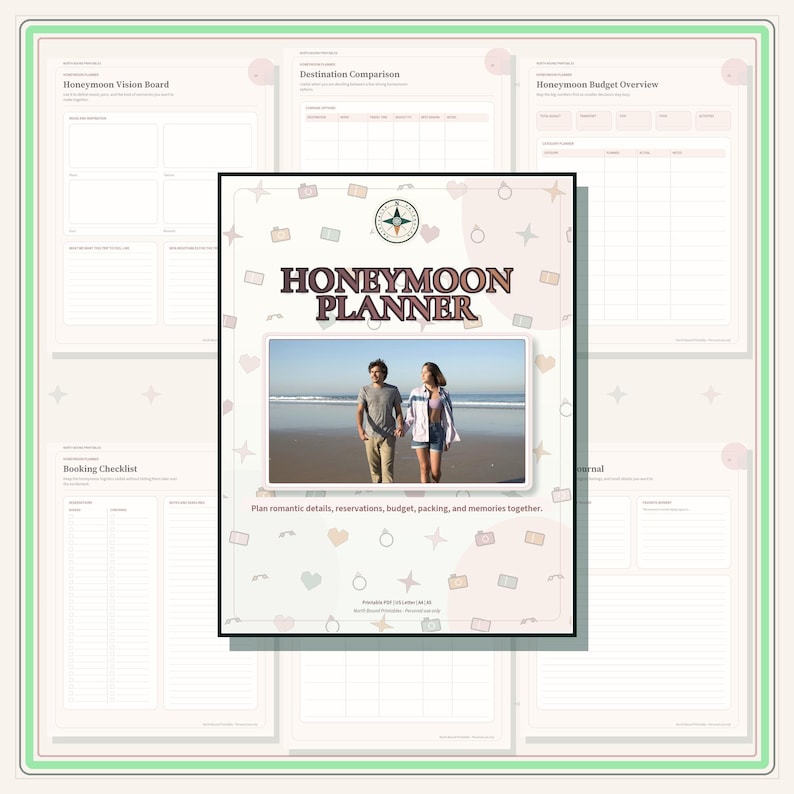
Our original Honeymoon Planner is a separate 17-page product with a vision board, destination comparison, budget and other planning pages. The completed examples on this guide belong only to the Illustrated Edition. Compare each product's own page list and previews below. Purchases and delivery take place on Etsy. The illustrated PDFs are for handwriting, not editable templates or fillable forms. If you only need a daily schedule, try the free itinerary linked below first.
Official planning references
More useful trip resources
Put the guide into practice
Related printable planners
Friends & Couples
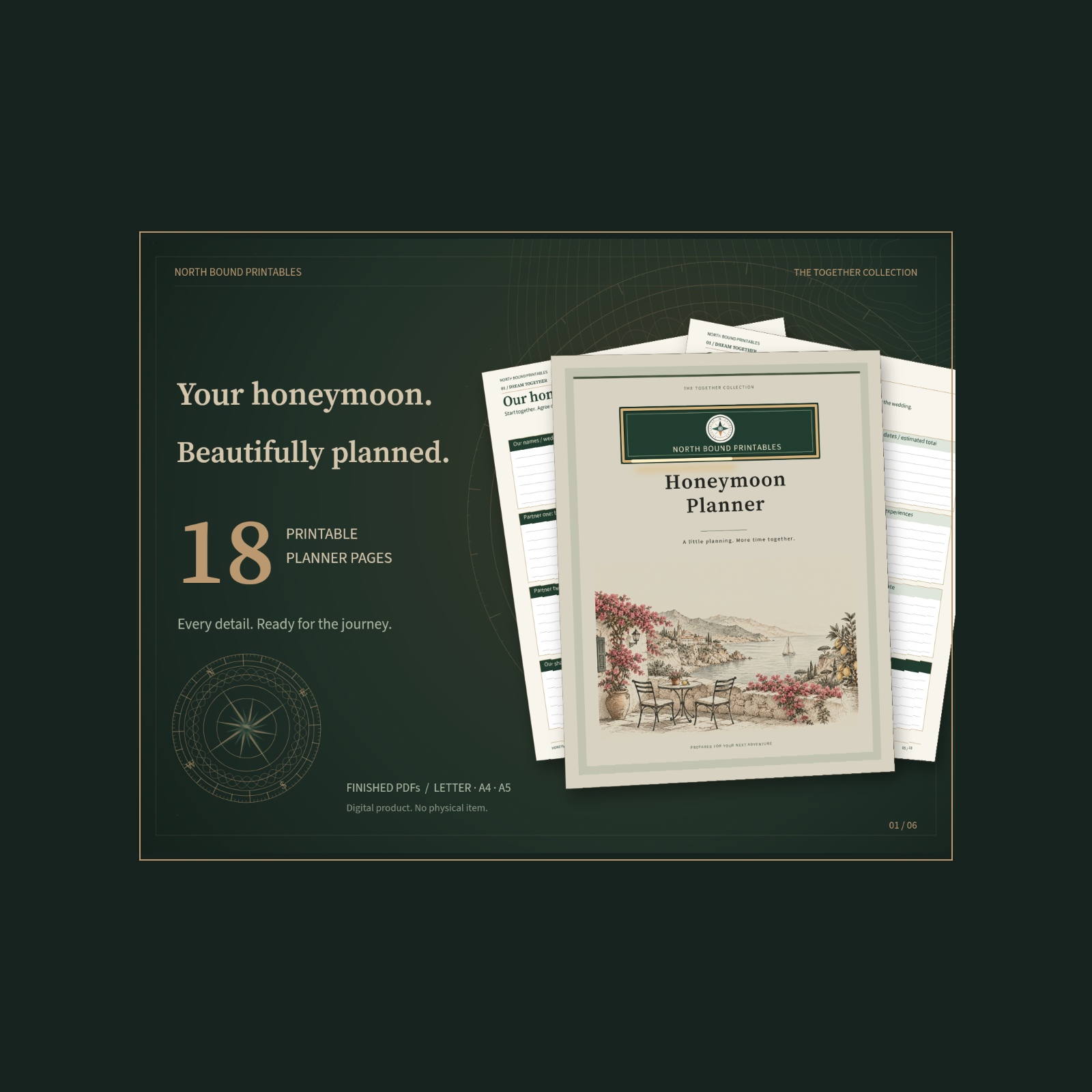
Honeymoon Planner - Illustrated Edition
Plan your honeymoon together with 18 printable pages for shared priorities, budget, bookings and packing. Letter, A4 and A5 PDFs through Etsy.
Friends & Couples
Honeymoon Planner
Compare honeymoon destinations and organize bookings, budget and packing with the original printable Honeymoon Planner. Download through Etsy.