
Airport planning guide
Plan your airport day, from home to gate
Build an airport travel checklist with separate check-in, bag-drop and boarding deadlines. See a fictional departure-day example and plan bags and connections.

- Start with the confirmed booking
- One flight
- Check-in, bag drop and gate
- Separate times
- Allowance, contents and location
- Each bag
Start with the booking, not a generic arrival time
Open your actual booking and record the operating airline, flight number, date, departure airport and terminal. Keep the original confirmation available offline. A city can have several airports, and a terminal can change, so check the current airline and airport information again before leaving.
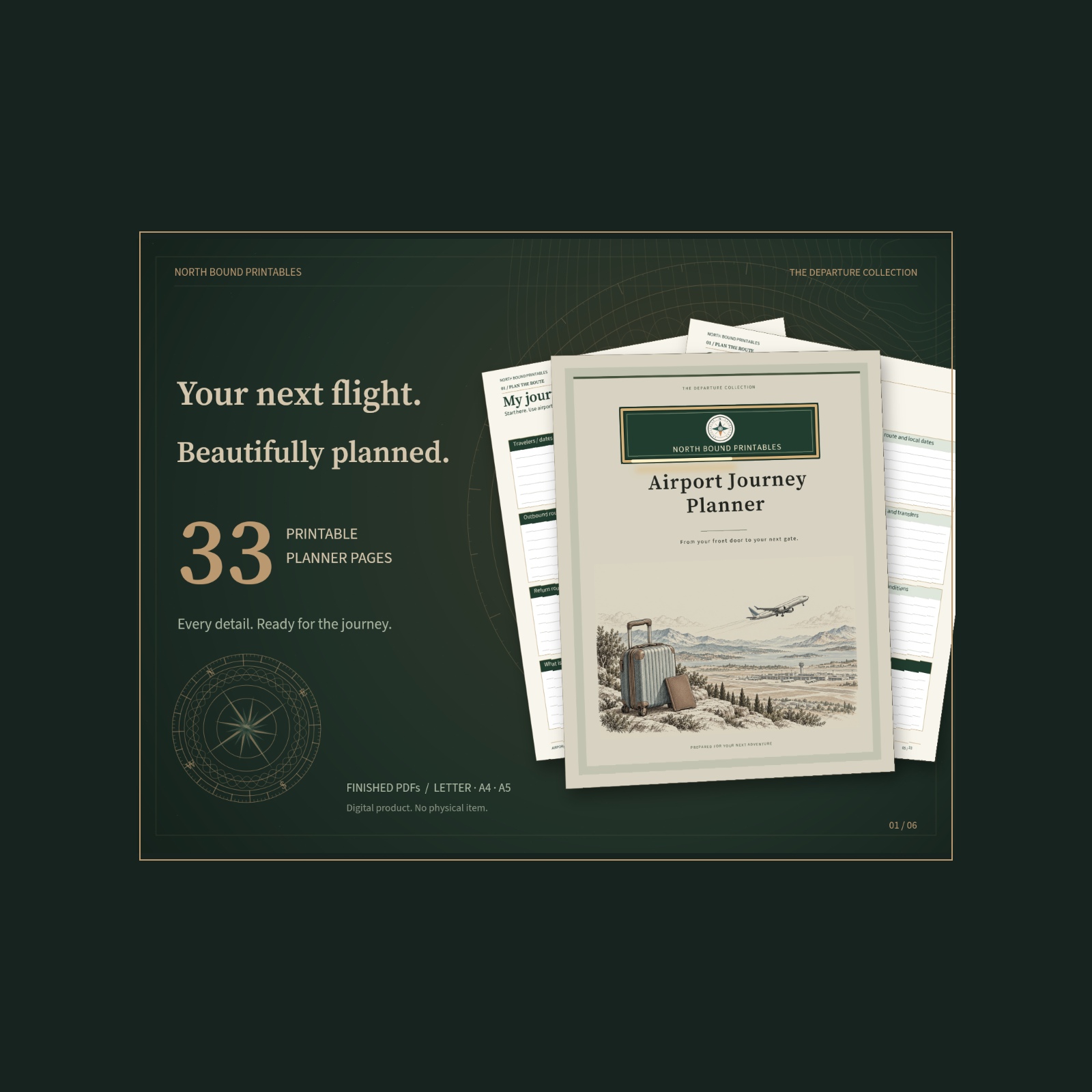
In the Airport Journey Planner, start with My journey at a glance on page 4, One booked flight on page 8 and Check-in and key deadlines on page 10. These page references belong to the 33-page illustrated planner, not our original 26-page Airport Travel Planner. Use one booked-flight sheet for each leg and label departure and arrival dates and local time zones separately.
Give every deadline its own answer
For each deadline, write the date and time, what must be finished, the source and when you checked it. Keep your personal target arrival separate from the provider's cutoff. The British Airways reference below illustrates how even one airline publishes different check-in deadlines by airport and route; it is not guidance for every airline.
If you cannot find an answer, mark it OPEN and add a follow-up to My booking action list on page 6. Online check-in does not by itself confirm that document checks or baggage steps are finished. Follow the instructions for your booking.
| Record | Find the answer in |
|---|---|
| Check-in opening and closing | Airline booking or current check-in guidance; include the date. |
| Bag-drop closing time, if needed | Airline instructions for that airport and flight. |
| Boarding and gate deadline | Boarding pass and current airline information; monitor changes. |
| Your planned terminal arrival | Your own plan, allowing for transport, queues, assistance and the confirmed deadlines. |
See a departure-day plan worked through
Riley is taking a fictional 14:00 flight on 8 June from Seabrook Airport, Terminal 1. Every place, arrangement and time here is invented. All times use the same fictional departure-airport time zone, UTC+02. This example demonstrates the fields in My departure-day timeline on page 20; it is not a recommended airport arrival window or a real flight plan.
Riley's invented provider instructions list 12:45 as bag-drop closure and 13:35 as gate closure. Riley plans to arrive before those cutoffs and includes ground travel, a possible road delay, baggage, screening and the walk to the gate. Actual queues and walking times are not predictable from this example. Replace all entries using your own verified instructions and circumstances.
| Time | Plan or deadline |
|---|---|
| 09:45 | Leave home; fictional pre-booked ride. |
| 10:30 | Expected terminal arrival after a fictional 45-minute drive. |
| 11:00 | Personal fallback arrival target allowing 30 extra minutes for the road; not an airline rule. |
| 11:00-12:45 | Planned window for remaining check-in, bag drop, screening and finding the gate. Reassess if queues or arrangements change. |
| 12:45 | Invented bag-drop closing time, not the planned time to join its queue. |
| 13:00 | Personal target to be at the gate; watch current displays and listen for instructions. |
| 13:35 | Invented gate-closing deadline. |
| 14:00 | Invented scheduled departure. |
Pack to your allowance, then record where things go
Use My baggage allowance on page 11 for the limits attached to your fare and each operating airline. A personal item, cabin bag and checked bag are not interchangeable. Record permitted dimensions, weight, quantity and any fee from the provider before deciding which bag to use.
Pages 15 to 17 separate personal-item essentials, cabin-bag essentials and checked-bag extras. They include suggested items with space for quantities and bag locations; cross out what does not fit your trip and add your own items. Check the relevant screening authority and airline rules for liquids, batteries, medicines and special items. The TSA link below covers U.S. screening, not every country or airline.
- Keep required original travel documents accessible and protect private booking details.
- Record which bag holds each shared item so you do not count it twice.
- Use If my cabin bag is checked on page 18 to note what you must remove or keep with you under the applicable rules.
- Use the full lined Miscellaneous items sheet on page 32 for anything not covered. Reprint it whenever you need more space.
Check the path through a connection
A connection is more than the time between two scheduled flights. Record the arrival and onward terminals, whether baggage must be collected and rechecked, any border or security steps, and the next flight's deadlines. Confirm the route and requirements with your airlines, airports and relevant authorities.
Use My connection plan on page 22 and, when relevant, Separate-ticket transfer on page 23. Do not assume separate tickets have the same baggage arrangements or disruption protection as one booking. If anything is uncertain, record the question and provider response before relying on the transfer. A worksheet cannot determine whether a connection is achievable or guarantee a protected onward journey.
Keep assistance and backup details easy to find
If you need assistance, record the request, the provider's confirmation, the meeting place and how to contact them on the day. Use Assistance and personal needs on page 13, not just a tick beside 'requested.' Confirm equipment and personal arrangements directly with the relevant providers.
Use the disruption and missing-bag pages only if needed. Save the airline's official contact, keep receipts and record what staff tell you. This is an organization tool, not a determination of refund, compensation or insurance eligibility. Recheck the return flight rather than carrying over outbound deadlines or baggage assumptions.
Choose the airport planner that fits your trip
The Airport Journey Planner has 33 pages, including 29 working sheets, three prefilled packing sheets and the full Miscellaneous items page. It covers bookings, route-specific deadlines, connections, separate-ticket transfers and optional disruption records. You do not have to fill every page: start with your booked flight, deadlines and journey to the terminal.
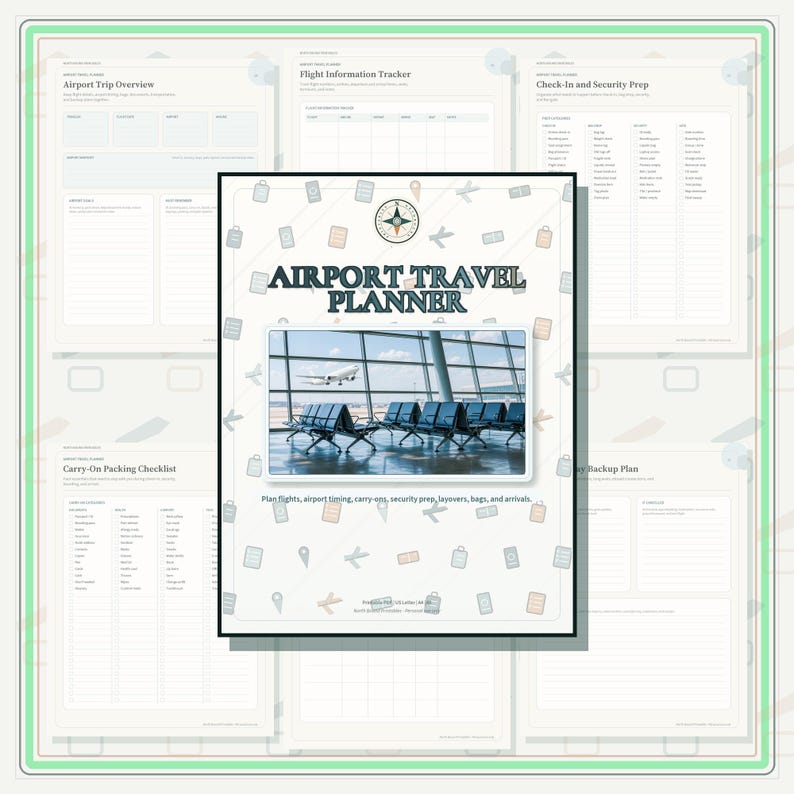
The original Airport Travel Planner is a separate 26-page product with flight information, airport preparation, packing and travel-day pages. Compare each product's own previews and page list below; the page numbers in this guide refer only to Airport Journey. Both products supply their listed content in US Letter, A4 and A5 for handwriting, not editable templates or fillable forms. Purchases and downloads take place on Etsy. If a simple daily schedule is all you need, try the free itinerary linked below first.
Official planning references
More useful trip resources
Put the guide into practice
Related printable planners
International & Documents
Airport Journey Planner
33 printable pages for flights, baggage, airport deadlines, connections and the journey home.
International & Documents
Airport Travel Planner
Flight itineraries and carry-on checklists for airport days.